
Starting your Dutch journey can feel like a maze of codes. You hear people talk about ‘getting to A2’ or “needing B1 for work.” But what do these levels actually mean for your daily life in the Netherlands? In this guide, we break down the CEFR levels specifically for expats living and working in Utrecht.
The Common European Framework of Reference for Languages (CEFR) is the international standard for describing language ability. It uses a six-point scale, from A1 for beginners, up to C2 for those who have mastered a language. At Tijd voor Taal in Utrecht, we focus on the most crucial levels for students.
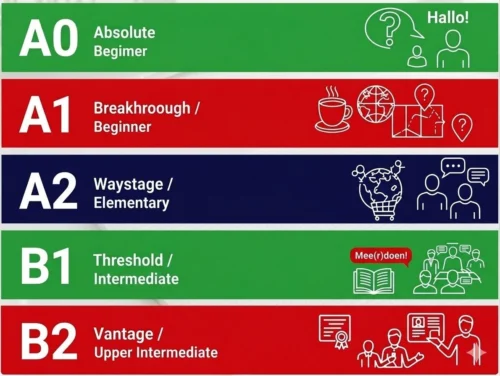
✅ You learn basic words and the sounds of the Dutch language.
✅ You can introduce yourself, ask for directions, and order a drink at a terrace on the Oudegracht.
✅ You can handle everyday tasks and have simple conversations with neighbors or colleagues.
✅ B1 Intermediate:
At this level, you can comfortably work in a Dutch-speaking environment and understand the main points of news reports.
✅ B2 Upper Intermediate:
You can express yourself fluently and spontaneously. You are able to follow complex technical discussions in your field of expertise.
Reaching a new level is not just about memorizing grammar; it is about active communication.
Because Tijd voor Taal works with groups of maximum 4 students, you get the individual attention needed to progress much faster. More speaking time means more confidence