
If you want to learn Dutch, you’ll quickly face an important choice: should you join a large class, or is a smaller group a better fit? At Tijd voor Taal in Utrecht, I deliberately work with groups of a maximum of four students. Not only because it’s more enjoyable, but because it significantly improves the quality of learning. In this article, you’ll discover why small groups are far more effective than large classes.
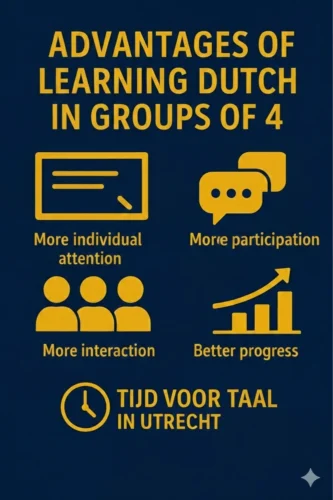
In a group of ten or even twenty students, it’s impossible for a teacher to give everyone enough time. Some learners barely get a chance to speak.
✅ You receive individual feedback every lesson;
✅ I can hear exactly where you struggle;
✅ There’s room to ask questions without holding up the whole class.
This helps you feel more confident and make much faster progress.
You don’t learn a language by listening alone, you learn it by using it. In small groups, everyone has to speak, and that’s exactly what accelerates your learning.
✅ speak much more;
✅ work with meaningfull role-plays;
✅ complete short tasks that are discussed immediately.
You stay actively engaged, helping your brain absorb Dutch more quickly and naturally.
For many learners, speaking Dutch can feel intimidating. You might worry about making mistakes or not finding the right words.
✅ You get to know one another quickly;
✅ You feel safe to experiment;
✅ You can laugh together, even about the mistakes (we all make them!).
A relaxed mind learns languages more easily.
✅ You get to know one another quickly;
✅ You feel safe to experiment;
✅ You can laugh together, even about the mistakes (we all make them!).
A relaxed mind learns languages more easily.
I always try to match students based on level, motivation and interests. In large classes this is nearly impossible, but in small groups, it works beautifully.
✅ Everyone learns at the same pace;
✅ Conversations feel meaningful and relevant;
✅ The group stays motivated and connected.
If you are preparing for the Staatsexamen NT2, targeted support is essential.
✅ more focused guidance;
✅ opportunities to practise real exam tasks;
✅ immediate, personal feedback you can apply right away.
This significantly increases your chances of passing.
Learning Dutch in small groups of four gives you the ideal mix of personal attention, safety and intensive practice. You learn faster, feel more confident, and enjoy the process much more with far better results.